Where History Inspires the Future
Build It. Fly It. Program It. Solve It.
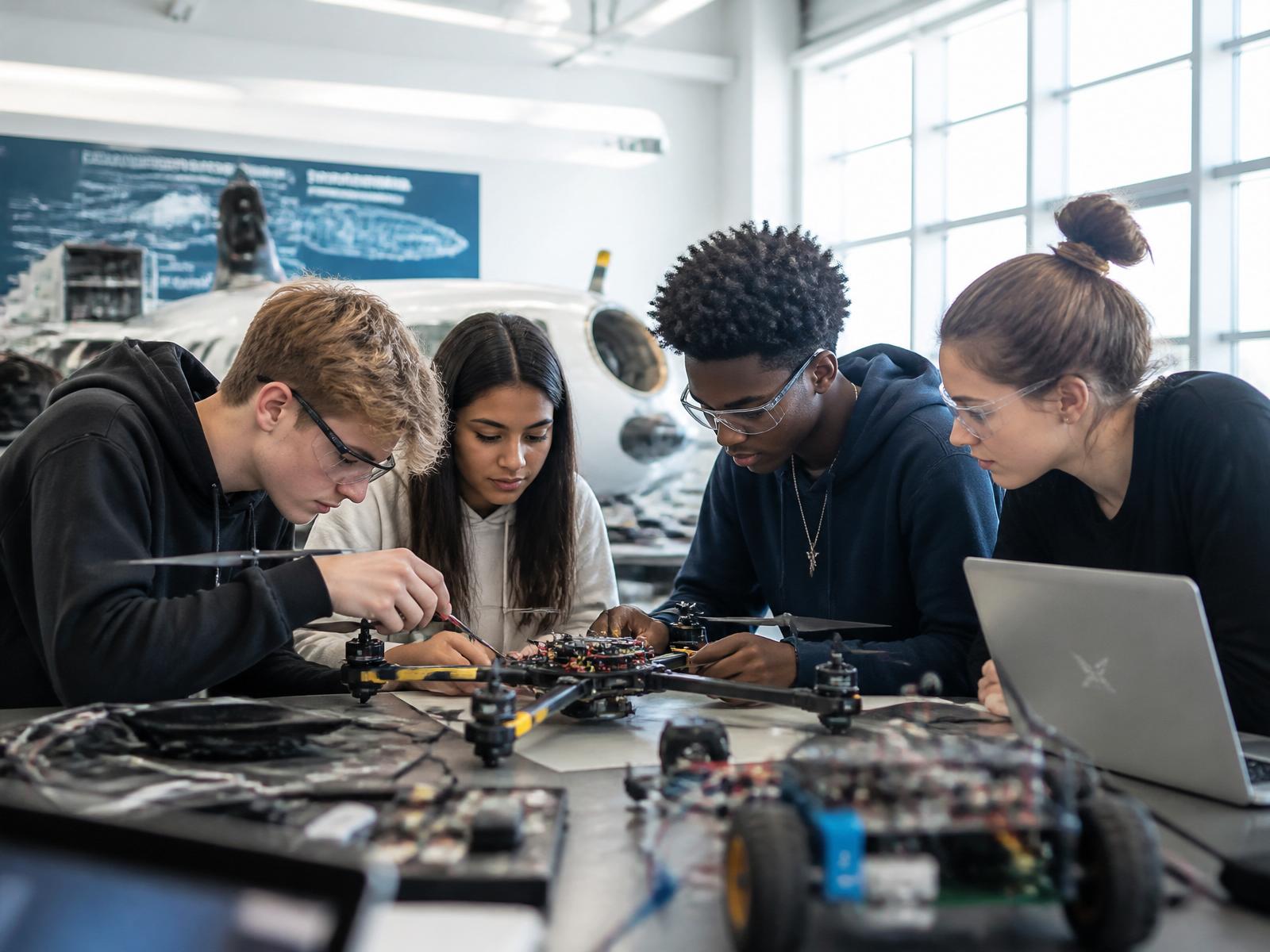
The National Military Helicopter Museum & STEM Learning Center will create a new kind of learning environment—one where students don't just read about science and technology.
They experience it.
Surrounded by real military aircraft, restoration projects, flight systems, robotics, drones, medical technology, and emerging vertical flight technologies, students will learn by building, testing, solving, and creating.
The STEM Learning Center will connect the remarkable history of military aviation with the technologies shaping the future of aerospace, defense, medicine, engineering, and advanced manufacturing.
Our goal is simple: inspire the next generation to become the people who build what comes next.
A helicopter is more than an aircraft.
It is an engineering system.

Inside one machine are lessons in:
The STEM Learning Center will use the museum's aircraft as a living laboratory—turning history into hands-on education.
Students will be able to stand beside the aircraft, examine its systems, understand how it works, and then apply those same principles to build something of their own.
Physics
Aerodynamics, lift, torque, and the forces that make vertical flight possible.
Mathematics
Flight calculations, geometry, and data analysis behind every maneuver.
Computer Science
The software logic that controls navigation, sensors, and autonomous systems.
Materials Science
Composites, alloys, and structural materials built to withstand extreme stress.
Electronics
Wiring, sensors, avionics, and the electrical systems that power flight.
Mechanical Engineering
Rotors, transmissions, landing gear, and the mechanics of controlled flight.
Software
Code that turns sensor input into real-time decisions and flight control.
Human Factors
Ergonomics, decision-making, and the human-machine interface in the cockpit.
Artificial Intelligence
Machine learning, computer vision, and intelligent systems for modern aircraft.
Manufacturing
Precision fabrication, assembly, and advanced production techniques.
Learn by Doing
Traditional education teaches concepts.
The STEM Learning Center will challenge students to apply them.
Every program will emphasize creativity, teamwork, problem-solving, communication, and the confidence to tackle challenges that don't have easy answers.
Connecting Arizona Students to the World
The STEM Learning Center will provide a platform for students to participate in high-level robotics and STEM experiences with opportunities to connect locally, nationally, and globally.
FIRST Global's international robotics challenge brings students from nations around the world together to build and program robots while collaborating around major global challenges.
The Center will use this model of collaboration to help students understand that STEM isn't simply about building machines.
It's about building solutions.
Endless possibilities.
The Science Behind Vertical Flight

Every aircraft on campus is an engineering system students can study, disassemble on paper, model in CAD, and rebuild in their own designs.
Students will explore the forces, structures, and systems that make vertical flight possible:
Engineering isn't learned from a diagram. It's learned by standing beside the machine and asking why it works.
Understand the aircraft. Then design the next one.
The Future Is Taking Off

The next generation of aviation will increasingly involve autonomous systems, unmanned aircraft, artificial intelligence, advanced sensors, and new approaches to vertical flight.
Students will have opportunities to explore these technologies through hands-on projects involving:
The goal isn't simply to teach students how to operate a drone.
It's to teach them how to engineer what comes next.
Build It. Break It. Make It Better.

Robotics transforms STEM concepts into something students can see, touch, build, and improve—week after week, iteration after iteration.
Competition teams, open build nights, and mentor-led programs give students a place to develop real engineering habits:
Robots are the vehicle. Problem-solving, teamwork, and confidence are the outcome.
More than building robots—building engineers.
Intelligence Meets Aviation

AI is changing aerospace, defense, medicine, manufacturing, and virtually every technology-driven industry.
Students will explore practical applications of AI through projects involving:
The Center will introduce students to AI as a tool for solving real problems—not simply as a technology to study.
Where Aviation Meets Medicine

The STEM vision extends beyond aerospace.
A dedicated medical technology component of the campus will explore the intersection of aviation, emergency medicine, engineering, robotics, and healthcare.
With a focus on aeromedical innovation and medical evacuation, students will learn how technology can help save lives when time matters most.
The campus will create opportunities for collaboration with healthcare, medical education, aerospace, and technology organizations—including potential collaboration with the world-class medical ecosystem surrounding Mayo Clinic.
History You Can Touch


A textbook can tell you how a helicopter works.
Standing next to one is different.
Students will have the opportunity to learn from historic aircraft and aviation systems while seeing the engineering decisions, maintenance challenges, and technological innovations that shaped them.
Building Arizona's Future Workforce
Arizona is home to a growing aerospace, defense, semiconductor, manufacturing, technology, and healthcare ecosystem.
The STEM Learning Center will help create a pipeline connecting students to the industries that will define Arizona's future.
Exposure
Show students what careers are possible.
Experience
Give them hands-on opportunities to build real skills.
Mentorship
Connect students with engineers, technicians, pilots, physicians, scientists, veterans, and industry professionals.
Education
Provide advanced learning opportunities beyond the traditional classroom.
Career Pathways
Connect students to internships, apprenticeships, certifications, higher education, and employment opportunities.
Leadership
Develop the confidence and communication skills required to lead.
From elementary to workforce.
Elementary
- —Robotics
- —Building challenges
- —Aviation discovery
- —Coding
- —Science experiments
- —Drone demonstrations
Middle School
- —Engineering
- —Robotics
- —Coding
- —Electronics
- —Aircraft systems
- —Drone technology
- —Design challenges
High School
- —Advanced robotics
- —Aerospace engineering
- —AI
- —Autonomous systems
- —CAD
- —Advanced manufacturing
- —Aviation mechanics
- —Medical technology
- —Internships
- —Industry mentorship
College & Emerging Professionals
- —Aerospace
- —Defense
- —Engineering
- —Medicine
- —Robotics
- —AI
- —Manufacturing
- —Aviation
- —Research
Adults & Workforce
- —Technical training
- —Professional development
- —Aviation education
- —Robotics
- —Emerging technology
- —Workforce reskilling
- —Industry workshops
Build. Design. Fly. Solve.
Aviation & Aerospace Camps
Build. Design. Fly.
Robotics Academies
Build competitive robots and develop engineering and leadership skills.
Drone Academies
Design, program, and operate unmanned aircraft.
Future Flight Labs
Explore autonomous systems, AI, and emerging vertical flight technologies.
Medical Innovation Challenges
Solve real-world problems in emergency medicine and aeromedical technology.
Teacher Training
Give educators access to advanced STEM tools, curriculum, and industry mentors.
Imagine What You Could Build

A dedicated maker and innovation environment will give students access to tools and technologies such as:
Students won't simply consume technology.
They will create it.
Learn From the People Building the Future

The Center will create a network of mentors from Arizona's aerospace, defense, healthcare, technology, manufacturing, education, and military communities.
Students may learn directly from:
These relationships can transform a student's understanding of what is possible.
Every generation inherits problems it did not create.
Every generation also has the opportunity to solve them.
The STEM Learning Center will challenge students to become problem-solvers—not simply test-takers.
To ask:
The STEM Learning Center will be built by a community.
We need:
Together, we can create a place where a student walks into a museum and sees an aircraft—
and walks out believing:
“I could build the next one.”
From history to the future.
The National Military Helicopter Museum & STEM Learning Center will preserve the machines that changed aviation history while giving students the tools to shape what comes next.
The next generation is ready.
Let's give them the tools to build it.
